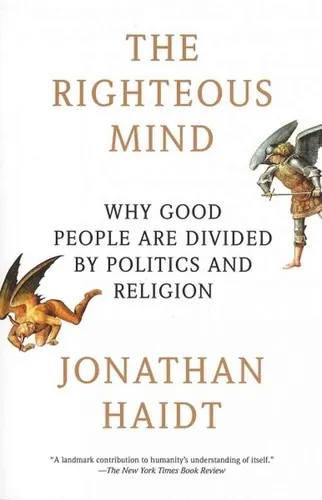
The Righteous Mind
by Jonathan Haidt
Combining experimental findings, cross-cultural observation, and evolutionary reasoning, The Righteous Mind offers a psychological account of how people form moral judgments and why they often talk past one another. Haidt contends that moral intuitions come first and reasoning follows as a post-hoc justifier. He introduces the moral foundations framework—care/harm, fairness/reciprocity, loyalty/betrayal, authority/subversion, and sanctity/degradation—and shows how different mixes of these foundations shape political and social perspectives. The book explores moral development, the role of emotion and social instincts, and how communities use shared moral narratives to promote cooperation and cohesion. Rather than prescribing specific policies, Haidt aims to foster understanding: he provides tools for recognizing the moral logic of opposing views, reducing polarization, and improving dialogue across divides. Readers interested in moral dilemmas, justice and fairness, or the psychology of wisdom will find a clear synthesis of research and practical insight into how moral beliefs form, bind groups, and complicate public life.
- ISBN
- 9789025908362
- Publisher
- Pantheon
- Pages
- 419