Best Books About Self-Discipline by Marcus Aurelius

There is a book that has been read continuously for nearly two thousand years, and it was never meant to be read at all. Meditations - the private notebook of Marcus Aurelius, emperor of Rome - is the most famous self-discipline book ever written, and it is also the strangest: a man at the height of worldly power writing notes to himself about the discipline of the inner life. It has survived because it works - because the practice it records is the practice every serious reader has needed since.
This guide collects the books that belong on the Marcus Aurelius shelf: the essential text itself, the other great sources of the Stoic tradition, and the modern books that translate the practice for contemporary life. Whether you are new to the emperor or returning to him, the reading path below will take you from the notebook to the practice.
What Marcus Aurelius Is Really Teaching
Before the recommendations, it is worth being precise about what Meditations actually is, because it is often misread. It is not a treatise; it is a journal - the private notes of a man training himself. Marcus wrote in fragments, to himself, in the middle of a life that included plague, war and betrayal. The book’s power is exactly that: it is not advice from a distance but practice from the inside. The reader watches an emperor reminding himself, again and again, of the same lessons - that his judgments are his own, that the world will do what it will, that the only thing in his power is how he meets it. The repetition is not a flaw; it is the point. Discipline is not a discovery but a daily re-reminding.
The central teaching is the Stoic dichotomy of control: some things are up to us - our judgments, our choices, our attitudes - and some things are not. The disciplined life is the life that stops wasting energy on what is not up to us and spends it entirely on what is. That teaching, repeated across the centuries, is the foundation of the whole self-discipline tradition.
The Essential Marcus Aurelius
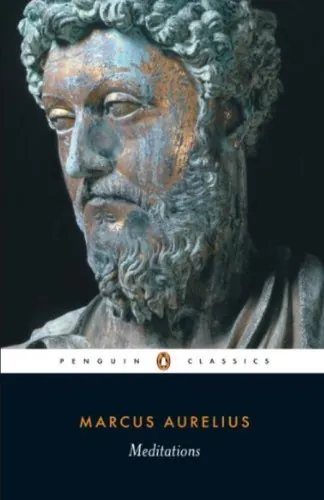
Meditations by Marcus Aurelius
This is the book, and it remains the essential title on this shelf. Meditations collects the emperor’s private notes - on duty, on death, on anger, on the shortness of life, on the people who annoy us and the discipline of understanding them. It is not organized; it is a journal, and the lack of organization is part of its truth: this is what daily practice actually looks like, fragment by fragment.
The book’s greatest strength is its honesty. Marcus is not performing wisdom; he is practicing it, and the reader can hear the effort. That is why the book has lasted while polished treatises have faded: it is the record of a human being doing the work, and the work is the same for an emperor and a reader.
Content notes: A classical text, accessible in modern translation, suitable for a wide range of readers.
The Meditations in Practice
One of the most useful ways to read Meditations is as a manual of daily practice rather than a text to finish. The Stoics understood that philosophy is not reading but training - that a principle is worthless until it has been exercised. Marcus’s notebook shows what the training looks like: the morning reminder of the day’s difficulties and one’s own resources; the evening audit of the day’s judgments; the repeated re-framing of annoyances, losses and fears. Readers who approach the book this way - a passage a day, held against the day’s events - find that it works the way it worked for the emperor.
That is also why Meditations rewards rereading more than almost any book. The passages do not change, but the reader does, and the same line means something different at twenty, forty and sixty. It is a book that grows with you, which is the signature of genuine wisdom literature.
The Stoic Tradition
Discourses by Epictetus
For readers who want the teaching in its clearest form, Discourses is the essential companion. Epictetus - a former slave who became the most influential Stoic teacher - lectures his students on the discipline with a sharpness Marcus never allows himself: the dichotomy of control, the training of desire, the freedom that comes from wanting only what is up to you. Where Marcus whispers to himself, Epictetus teaches out loud.
The two books are the perfect pair. Epictetus gives you the doctrine in full; Marcus shows you the doctrine in practice. Reading them together is the complete Stoic education.
Content notes: A classical text, demanding but accessible in modern translation, suitable for serious readers.
Letters from a Stoic by Seneca
For readers who want the practice in its most human form, Letters from a Stoic is the essential book. Seneca’s letters - written to his friend Lucilius on the daily business of living well - are the warmest surviving documents of Stoicism: the philosophy as correspondence, the discipline as conversation. Where Marcus writes to himself, Seneca writes to a friend.
The book is the most approachable entry point to the tradition, and it is the book for readers who want the discipline without the austerity.
Content notes: A classical text, accessible in modern translation, suitable for a wide range of readers.
The Daily Stoic by Ryan Holiday and Stephen Hanselman
For readers who want the practice made contemporary, The Daily Stoic is the essential book. Holiday and Hanselman’s collection of 366 daily readings - one passage from the Stoic tradition for every day of the year, with commentary - is Meditations made into a habit. It is the bridge from the ancient notebook to the modern morning.
The book is the perfect daily companion to the deeper sources, and it is the book for readers who want the discipline installed as a routine.
Content notes: Daily readings, accessible and suitable for a wide range of readers.
The Discipline of the Emperor
There is a point where the Stoic books meet the courage shelf, and Marcus is the hinge. The discipline he practiced was not the discipline of the monastery; it was the discipline of power - the training required to hold the highest office in the world without being corrupted by it, to command armies without becoming cruel, to be betrayed without becoming bitter. That is courage of a particular kind, and it is the kind the modern courage books explore.
Marcus and the Idea of the Inner Citadel
One of the deepest images in the Stoic tradition is the inner citadel - the stronghold of the self that no external force can breach. Marcus returned to it constantly: the mind that has disciplined its judgments is a fortress, and the world can besiege it but cannot take it. The emperor who could command the legions of Rome was, in his own account, most concerned with the fortress inside himself - the place where his values lived, untouched by the disasters and temptations of his position.
That is why Meditations belongs at the foundation of the self-discipline tradition. Every modern discipline book is, in some sense, a footnote to the emperor’s notebook: the habit systems are strategies for the inner citadel; the focus practices are defenses of it; the courage books are celebrations of it. Marcus’s contribution is to have recorded the practice itself - the daily, fragmentary, honest work of training the self - and the record has been teaching readers ever since.
The Morning and Evening Practice
One of the most useful ways to read Meditations is as the record of a daily practice, and the practice had a shape that modern readers can borrow. In the morning, Marcus reminded himself of what the day would bring - the difficult people, the annoying situations, the temptations - and of his own resources for meeting them: the reason, the patience, the duty. The morning practice was prophylactic: it armed him before the day could disarm him. In the evening, he audited the day - what he had done well, where he had fallen short, what the day had taught him. The evening practice was reflective: it turned experience into learning.
That shape - prepare in the morning, review in the evening - is the oldest self-discipline practice in the Western tradition, and it is the ancestor of the modern habit of journaling and daily planning. The power of the practice is that it turns the abstract discipline into two fixed appointments, and the appointments do the work that motivation cannot. The reader who borrows even half of it - a morning reminder of the day’s likely difficulties, an evening question about how the day was met - will find that the discipline stops being something they think about and becomes something they do. That is the whole secret of Meditations: the emperor did not have more willpower than anyone else; he had a practice, and the practice was the discipline.
How to Build Your Reading Path
There is no wrong order on this shelf, but there is a sensible one. Start with Meditations in a good modern translation. Add The Daily Stoic for the daily practice, and Discourses when you want the doctrine in full. Add Letters from a Stoic when you want the warmth, and then return to Meditations - it is the book that repays the return.
The path moves from the practice to the doctrine and back to the practice, and that is the right direction. Our guide to meaningful self-discipline for adults gathers the wider shelf these titles belong to, and it is the natural next stop after you have worked through this one.
The Courage Shelf
There is a quiet but important connection between the Stoic shelf and the courage shelf, and it is worth naming one more time: what makes Meditations so durable is that it records courage in its least dramatic form. Marcus was not writing about battles; he was writing about the discipline of the ordinary day - the meeting, the annoyance, the temptation, the weariness. The courage he practiced was the courage of continuing, of keeping the inner citadel intact through a thousand small assaults. That is the courage the modern reader most needs, and it is the courage this shelf celebrates. The emperor’s notebook is, in the end, a manual for the bravery of the unremarkable day - and the unremarkable day, mastered, is the whole of a life.
The Courage Shelf
There is a quiet but important connection between the Stoic shelf and the courage shelf, and it is worth making explicit. The discipline Marcus practiced - accepting what cannot be changed, acting in the face of fear, refusing to be mastered by circumstance - is courage, and it is the quality the books on this shelf explore.
Our guide to meaningful courage for adults collects the titles that explore that territory most deeply - the books about the bravery of the inner life and the discipline that sustains it. Read them alongside the Marcus shelf and you get the complete picture: the practice of the emperor, and the courage it builds. Together they form part of the growth section of our library, where the whole shelf of discipline and daring is gathered.
Conclusion
Marcus Aurelius’s contribution to self-discipline is the original record of the practice: a notebook, never meant for publication, in which an emperor trained himself daily in the discipline of the inner life. It has been read for nearly two thousand years because it works - because the practice it records is the practice every reader has needed since. The books on this shelf take you from the notebook to the tradition, and from the tradition to the daily practice.
Start with Meditations, work outward through the doctrine and the daily readings, and end with the courage that the discipline builds. The judgments are yours; the world will do what it will; and the discipline of meeting it well is the whole of the art - a practice, as the emperor knew, for every day of a life.
Frequently Asked Questions
What is the best book by Marcus Aurelius for self-discipline?
What is the main idea of Meditations?
Is Meditations a self-discipline book?
What other Stoic books should I read?
Is Meditations suitable for modern readers?
How is Meditations different from modern self-help?
Featured Recommendations

Raining Book Editorial Team
The Raining Book editorial team curates the best book recommendations and reading guides for every type of reader.