Best Books About Personal Growth by James Clear

If you have come this far in your reading life, there is a good chance James Clear helped you get here. Atomic Habits - his book about building good habits, breaking bad ones, and mastering the tiny behaviors that compound into a life - has become one of the most influential personal growth books of its generation, and it has introduced millions of readers to a way of thinking about change that actually works.
This guide collects the books that belong on the James Clear shelf: the essential titles by Clear himself, the books that share his method, and the deeper works that extend his ideas into character, discipline and meaning. Whether you are new to habits or looking to go further, the reading path below will take you from the system to the person behind it.
What James Clear Is Really Teaching
Before the recommendations, it is worth being precise about what Clear actually argues, because the popular version of Atomic Habits misses the depth of it. The book is not a collection of productivity tricks; it is a theory of identity. Clear’s central claim is that habits are not something you have but something you are - that every action is a vote for the type of person you wish to become, and that the change happens not when you achieve a goal but when your identity shifts to match the behavior. You do not get fit by losing twenty pounds; you get fit by becoming the kind of person who does not miss a workout.
That is why the book has lasted when so many self-help titles fade. Clear is not selling motivation; he is selling a system - the four laws of behavior change, the idea of making habits obvious, attractive, easy and satisfying - and systems outlast enthusiasm. The reader finishes the book with tools, not just feelings, and the tools keep working long after the inspiration wears off.
The Essential James Clear
Atomic Habits by James Clear
This is the book that started it all, and it remains the essential title on this shelf. Atomic Habits presents the argument that small changes - 1 percent improvements, repeated daily - compound into remarkable results, and it builds a complete system for making those changes stick. Clear’s four laws of behavior change give the reader a practical framework: make it obvious, make it attractive, make it easy, make it satisfying.
The book’s greatest strength is its combination of depth and usability. Every chapter ends with actionable tools, but the ideas underneath - identity-based habits, the plateau of latent potential, the environment as the invisible hand of behavior - reward a careful reading. It is the rare personal growth book that is both a manual and a philosophy.
Content notes: Practical and accessible, suitable for a wide range of readers.
Clear’s Idea of the Plateau
One of the most important - and most quoted - ideas in Atomic Habits is the plateau of latent potential. Clear argues that habits often feel useless for a long time, because the results are delayed: you work for weeks and see nothing, then suddenly the breakthrough arrives, the way ice melts at thirty-two degrees after hours of warming. The lesson is not that the work failed but that it was accumulating invisibly. That idea has rescued countless readers from the most common cause of giving up - the belief that because nothing has changed yet, nothing will.
This is also where Clear’s thinking connects to the deeper growth shelf. The discipline to keep working through the plateau is not a technique; it is a quality of character. The books later in this guide explore that quality from every angle - the ancient Stoics who trained for it daily, the researchers who studied it scientifically, the memoirists who lived it under the hardest circumstances. Clear gives you the system; these books give you the endurance to run it.
The Books That Extend His Method
The Power of Habit by Charles Duhigg
If Atomic Habits is the how, The Power of Habit is the why. Duhigg’s book - built on the science of the habit loop of cue, routine and reward - explains why habits exist, how they are formed in the brain, and how organizations and individuals have changed them. It is the ideal companion to Clear because it answers the questions Atomic Habits assumes: why do habits have so much power over us, and why is changing them so hard?
The two books read beautifully together. Clear gives the framework; Duhigg gives the foundation. Readers who want to understand the machinery underneath the method will find The Power of Habit indispensable.
Content notes: A science-forward but accessible book, with vivid case studies, suitable for a wide range of readers.
Better Than Before by Gretchen Rubin
For readers who want the habit system tailored to personality, Better Than Before is the essential book. Rubin - whose work is covered more fully elsewhere on this shelf - argues that the single most important factor in habit change is knowing yourself: your tendencies, your temperament, the kind of structure that actually helps you. Her framework of the four tendencies explains why some people thrive on rules and others rebel against them.
The book complements Clear because it adds the personal variable. Atomic Habits gives everyone the same system; Better Than Before helps each reader adapt it to who they actually are. Together they cover the universal and the individual.
Content notes: Warm, practical and personal, suitable for a wide range of readers.
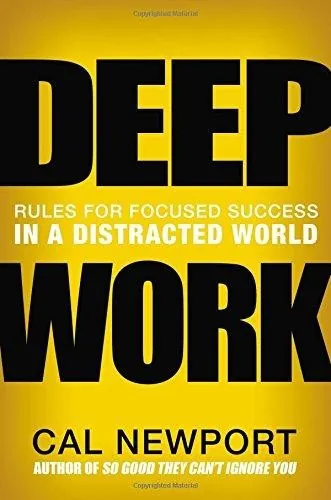
Deep Work by Cal Newport
For readers who want the habit system applied to the most valuable skill of the modern age, Deep Work is the essential book. Newport’s argument - that the ability to focus without distraction on a cognitively demanding task is becoming rarer and more valuable, and that it can be trained like a habit - extends Clear’s thinking into the territory of attention.
The book is a natural next step because it treats focus as a practice rather than a talent. Where Clear shows how to build the habit of showing up, Newport shows how to build the habit of showing up fully - the deep work sessions that produce the results shallow work cannot.
Content notes: Practical and rigorous, with clear strategies, suitable for professionals and students.
The Deeper Shelf: Character and Discipline
There is a point where the habit books end and something deeper begins. Clear’s system is magnificent, but it rests on an assumption: that the person running the system will keep running it. The books below are about that person - about the character that sustains discipline when the system is tested, the meaning that makes the effort worth taking, and the self-knowledge that turns habits into a life rather than a routine.
Man’s Search for Meaning by Viktor E. Frankl
For readers who want the deepest foundation of all, Man’s Search for Meaning is the essential book. Frankl - a psychiatrist who survived the concentration camps and wrote this book about what he learned there - argues that the primary drive in human life is not pleasure but meaning, and that those who had something to live for were the ones most likely to survive. His logotherapy - the therapy built on finding meaning - is the deepest answer to the question of why discipline matters.
The book is the perfect completion of the habit shelf. Clear shows you how to change; Frankl shows you why the change is worth making, even - especially - when everything is against you. The two books together are a complete education in personal growth.
Content notes: A profound and moving book, including accounts of suffering, suitable for mature readers.
Meditations by Marcus Aurelius
For readers who want the ancient source, Meditations is the essential book. The private notebook of the Roman emperor Marcus Aurelius - written for himself, never intended for publication - is the record of a man practicing self-discipline daily: auditing his judgments, accepting what he cannot control, doing his duty without complaint. It is the oldest book on this shelf and in some ways the most modern.
The book connects to Clear in a specific way: Marcus was practicing identity-based habits eighteen centuries before the phrase existed. He did not write about being a good emperor; he wrote reminders to himself about who he was, and the writing was the practice. Readers who loved the identity argument in Atomic Habits will find its ancient ancestor here.
Content notes: A classical text, accessible in modern translation, suitable for a wide range of readers.
The Four Laws of Behavior Change
No account of James Clear’s contribution is complete without naming the four laws, because they are the most practical part of his system and the part readers actually use. To build a good habit, Clear says, make it obvious, make it attractive, make it easy, make it satisfying. To break a bad one, invert the laws: make it invisible, make it unattractive, make it difficult, make it unsatisfying. The power of the framework is that it moves the fight from the will to the design - instead of relying on motivation in the moment, you arrange the environment so that the right behavior is the path of least resistance and the wrong behavior is the path of most.
That is why the system works where sheer willpower fails. Willpower is a finite resource, spent by every decision; design is permanent. Clear’s most practical insight - the two-minute rule, the habit stacking, the environment as the invisible hand - all follow from the same principle: stop trying to be strong in the moment, and start making the moment easy. Readers who apply even one of the four laws report that the habit stops feeling like a fight, which is exactly the point. The laws are the machinery; the identity is the fuel; and the character is the long-term result of running both.
How to Build Your Reading Path
There is no wrong order on this shelf, but there is a sensible one. Start with Atomic Habits for the system. Add The Power of Habit when you want the science underneath. Bring in Better Than Before when you need to adapt the system to your own temperament, and Deep Work when you are ready to apply it to focus. Then go deeper: Meditations for the ancient practice, and Man’s Search for Meaning for the ultimate answer to why the practice matters.
The path moves from the mechanical to the philosophical, and that is the right direction. The habit is the vehicle; the character is the driver; the meaning is the destination. Our guide to the best personal growth books gathers the wider shelf these titles belong to, and it is the natural next stop after you have worked through this one.
The Character Shelf
There is a quiet but important connection between the habit shelf and the character shelf, and it is worth making explicit. Clear’s system works - but only for people who keep running it, and keeping running it is not a habit problem; it is a character problem. That is why the books on character belong in this reading path: they are about the person who shows up, who keeps the promise to themselves, who does the unglamorous work when nobody is watching.
Our guide to the best character books collects the titles that explore that territory most deeply - the books about integrity, courage, honesty and the slow building of a self you can respect. Read them alongside the habit books and you get the complete picture: the system for changing, and the character that makes the change hold. Together they form part of the growth section of our library, where the whole shelf of becoming is gathered.
Conclusion
James Clear’s contribution to personal growth is a system that works - and a way of thinking about change that has helped millions of readers stop relying on motivation and start relying on design. But the system is only the beginning of the journey. The books on this shelf take you from the habit to the person: the science underneath it, the temperament that shapes it, the character that sustains it, and finally the meaning that makes it all worth doing.
Start with Atomic Habits, work outward through the science and the personality frameworks, and end with the ancients and the survivors who answer the deepest question of all. The habits will build the life; the character will keep it; the meaning will make it yours.
Frequently Asked Questions
What is the best book by James Clear for personal growth?
What is the main idea of Atomic Habits?
What other books are like Atomic Habits?
Is Atomic Habits based on research?
Is Atomic Habits suitable for beginners?
How long does it take to see results from habits?
Featured Recommendations


Raining Book Editorial Team
The Raining Book editorial team curates the best book recommendations and reading guides for every type of reader.